A salon shares a seasonal treatment on Instagram, adds a link to its Google Business Profile, and prints a QR code on a front-desk card. A month later, the owner can see more website visits but cannot tell which invitation brought them. The answer is to label the links before sending them out, then check what visitors and staff actually did. A campaign label is a small bookkeeping tool, not proof that a click became a customer.
For a local service business, a useful link plan can fit on one page. Choose the destination, name the source and campaign consistently, test the link on a phone, and compare visits with real inquiries. This guide shows that workflow without requiring an analytics specialist or an elaborate dashboard.
Start with the decision the report should support
Suppose a home service company puts a QR code on its service van, shares a roof-maintenance tip on Facebook and adds a link to a Google Business Profile update. The owner wants to know whether the van card deserves another print run, whether the Facebook topic leads to quote requests, and whether the profile link sends people to the right service page. Those are different questions. Write them down before creating labels.
Do not tag everything because a report can show it. If the business will not change its plan based on a post-by-post comparison, one link for the week's social campaign may be enough. A small, stable naming system gives a cleaner answer than dozens of nearly identical campaign names.
| Question | Link destination | What to check later |
|---|---|---|
| Did the van card bring visitors? | A relevant service or quote page | Tagged visits, then quote requests received |
| Did the spa post help guests choose a treatment? | That treatment's service page | Tagged visits, booking clicks, confirmed appointments in the booking tool |
| Did the profile update send people to the site? | A current service or offer page | Business Profile website clicks and tagged website sessions |
The destination should answer the promise made by the source. A QR code saying “request a pool-service estimate” should not open a generic homepage. The mobile quote form guide covers what happens after that visitor reaches the page.
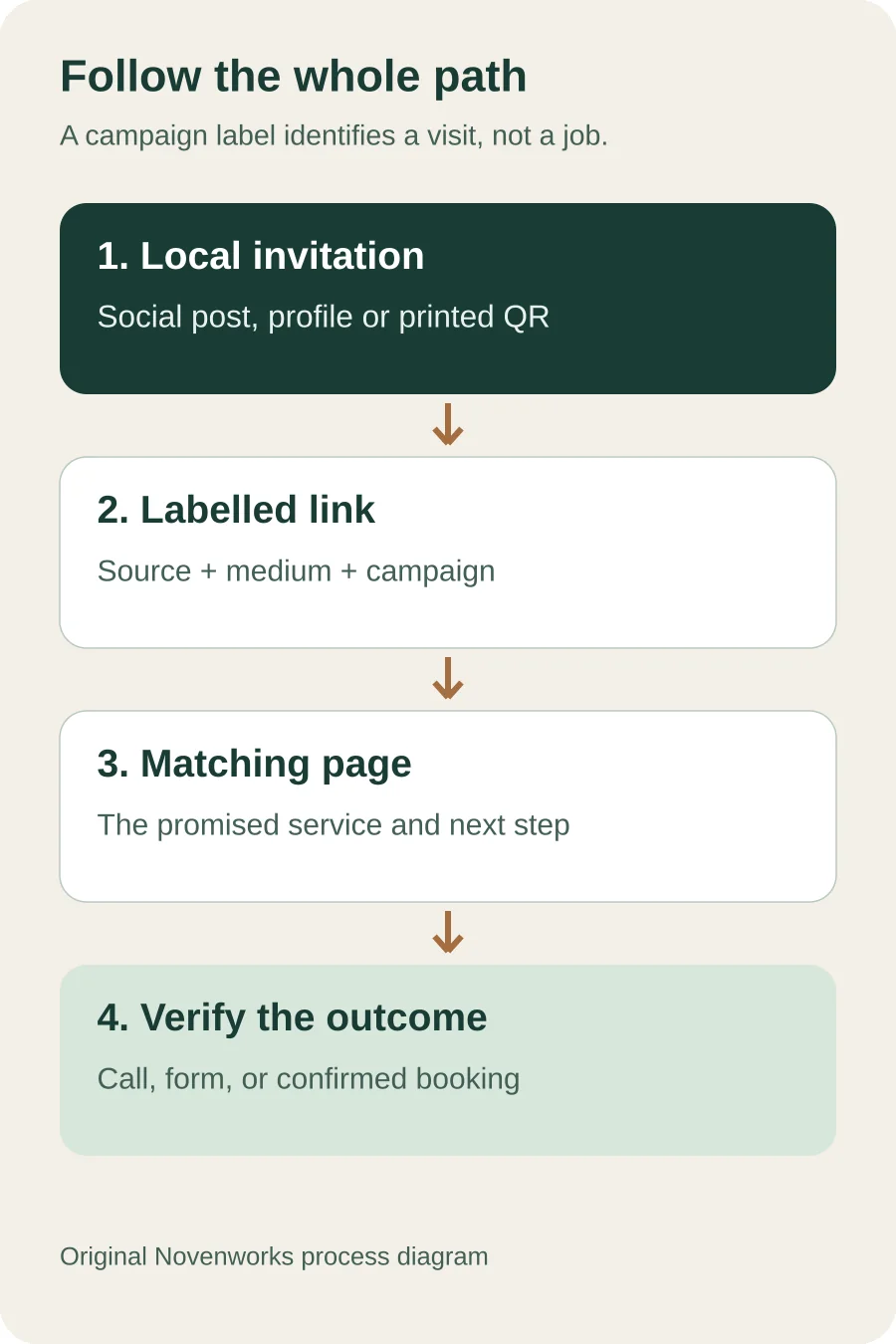
Use three labels first
A UTM link is a regular URL with fields such as utm_source, utm_medium and utm_campaign. Google Analytics' official URL-builder guide (opens another website) recommends these fields to identify campaign traffic. In plain terms, source names where the visitor came from, medium names the kind of placement, and campaign names the effort you want to compare.
For example, a salon might use source instagram, medium social, campaign winter_scalp_care. A contractor might use source van_qr, medium print, campaign fall_roof_check. These are example names, not required Google values. Keep them lowercase, predictable and documented so Instagram, instagram and ig do not become three rows for one source.
Use utm_content only when you need to distinguish two creative variations within the same campaign. Do not put customer names, phone numbers or other personal information in the URL. Campaign links get copied, forwarded, logged and sometimes shared publicly. Keep the labels about the marketing placement, not the person who clicked.
A one-page naming sheet
Write down the approved source values, medium values, campaign names, destination URLs and owner of each link. Keep a copy of the finished URL, not merely the individual fields. When a new staff member prints a QR code or updates a profile, they can reuse the same pattern. Review the sheet when an offer ends or a page moves.
If a link already contains a question mark, add the next parameter with &, not another ?. A URL builder can handle that detail. More important: open the finished link on a phone and confirm it lands on the intended page, preserves the correct service, and reaches a working call, form or booking action.
Only tag incoming links. Do not add UTM labels to buttons moving between pages on your own site; doing so can break the continuity of the visit's original source. Also avoid editing live ad platform links casually when automatic tagging or other tracking is configured. Check the channel's setup before changing a paid campaign.
Read the right report, then check the real outcome
In GA4, the Traffic acquisition report (opens another website) can show sessions by source, medium and campaign when your destination site has analytics configured and the link is used. A tagged session tells you that a visit reached the site with those labels. It does not say whether a phone call connected or a spa appointment was confirmed.
That distinction matters when a booking button sends the visitor to another provider. With enhanced measurement (opens another website), GA4 can record an outbound click when configured, but the website may still know only that the visitor left for a booking service. Look at the booking provider's appointment report and ask staff what they received. Our wellness booking handoff guide maps that gap in detail.
Google Business Profile has its own performance view (opens another website), including website clicks. Its click count and GA4 sessions need not be identical because they describe different events and can be affected by browser behavior and measurement settings. Use them as related clues, then test the customer path. If a new campaign produces clicks but no usable inquiries, the destination or offer may need work.
A practical monthly review
Pick a month with enough activity to see a pattern. For each campaign, write down the destination, tagged visits, the useful actions the site recorded, and the inquiries the team actually received. Ask whether the response was timely and whether the work was a fit. A campaign that brings five good estimate conversations can be more useful than one that brings many curiosity clicks.
When numbers disagree, test before making a budget decision. Open the link in a fresh browser, submit a safe test inquiry, and trace it into the inbox or booking tool. Check whether the analytics event fired once and whether staff can identify the campaign without reading a raw URL. The website analytics guide gives an owner-level view of the full measurement chain, while the lead follow-up guide covers what happens after an inquiry arrives.
Keep the system small enough to maintain. Retire labels with old offers, keep a record of QR codes still in circulation, and revisit destinations when pages move. The goal is a clearer decision about where to spend time and how to improve the visitor's next step, not a perfect attribution story that a small business cannot honestly support.